The Old Comparison Is Dead
For years, search results for "Crestron vs Lutron vs Savant" framed these companies as rivals fighting for the same automation dollar. That comparison no longer reflects reality. Savant completed its acquisition of GE Lighting in 2020 and has since pivoted hard into energy. The company now positions itself around the Savant Power System — a complete hardware platform for home battery storage, solar, generators, and intelligent load management.
The modern luxury home is not choosing between three automation brands. It is deploying three specialized platforms that each solve a different engineering problem. Crestron is the nervous system. Lutron is the lighting layer. Savant Power is the electrical backbone that keeps the home running when the grid does not.
Each platform is world-class at what it does. None of them tries to do what the others do best. A homeowner who understands this ends up with a system that is simpler, more reliable, and dramatically more capable than anything a single vendor could deliver.
Crestron — The Nervous System
Crestron is the industry standard for whole-home control and AV distribution. In the three-pillar model, Crestron is the nervous system. It is the platform that every subsystem reports into, and it is the interface the homeowner actually touches every day. Crestron Home OS is the residential platform and it has matured into something that is both powerful and genuinely user-friendly.
Crestron Home OS is dealer-configured, not overly custom, and does not require a programmer on-site for every small change. It runs on the same 4-Series hardware that powers commercial boardrooms, so reliability is not a question. The experience for the homeowner is clean and consistent across every touchpanel, tablet, and phone.
The Crestron hardware stack in a modern luxury home:
- •CP4-R 4-Series processor — the brain running Crestron Home OS. Secure, rack-mountable, industrial-grade. The same platform used in hospitals and broadcast studios.
- •DM NVX AV-over-IP — 4K HDR video distribution over standard Ethernet. No proprietary cabling, no distance limits, and no dedicated matrix switcher. Any source can go to any display.
- •TSW-770 and TSW-1070 touchpanels — 7-inch and 10.1-inch wall-mounted touchscreens. Clean glass fronts, capacitive touch, and the Crestron Home OS interface is polished enough that most users do not need training.
- •Crestron Home app — mirrors the touchpanel experience on any iPhone, iPad, or Apple Watch. Same layout, same scenes, same lighting controls.
- •Native integration with Lutron HomeWorks — Crestron communicates directly with the Lutron processor over LEAP, the Lutron network protocol. Lighting scenes, shade positions, and keypad button presses all flow bidirectionally.
- •Integration with every other subsystem — HVAC, security, intercom, cameras, audio, door locks, garage doors. If it has an IP or serial interface, Crestron talks to it.
What makes Crestron the right choice as the nervous system is the combination of reliability, breadth of integration, and a user interface that does not punish the homeowner for wanting to use their own house. Crestron Home OS handles every system in the home without forcing the homeowner to memorize which app controls what.
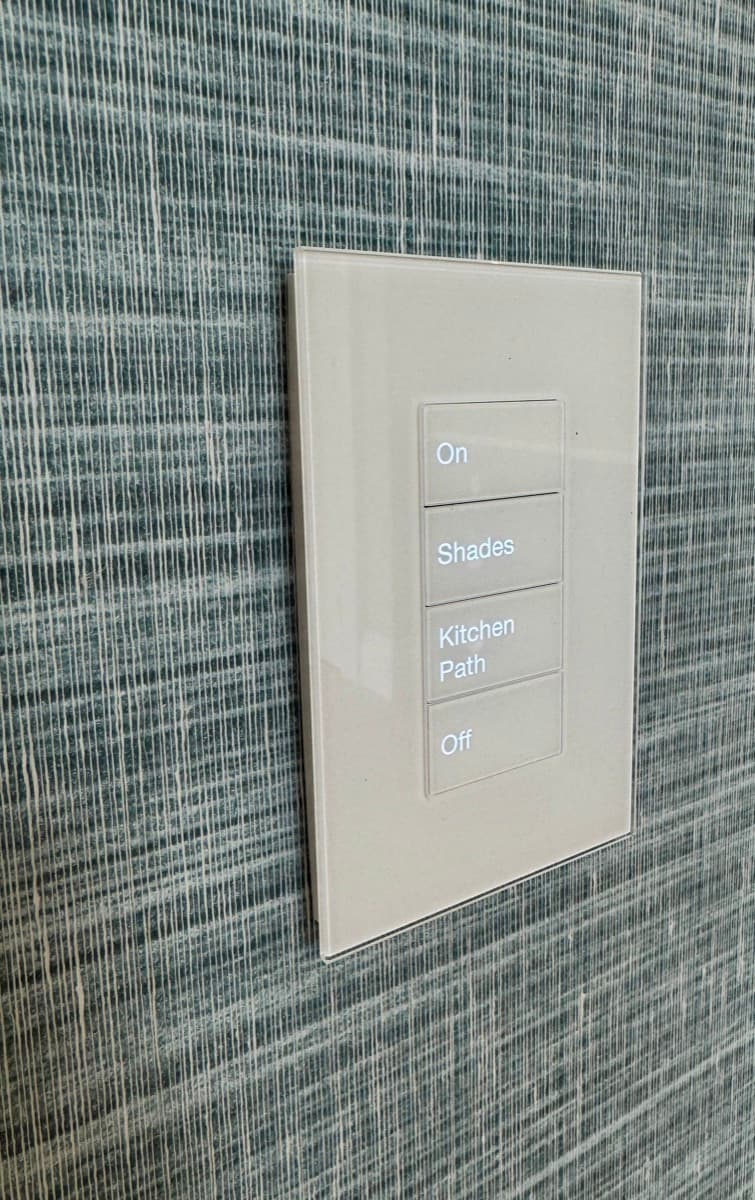
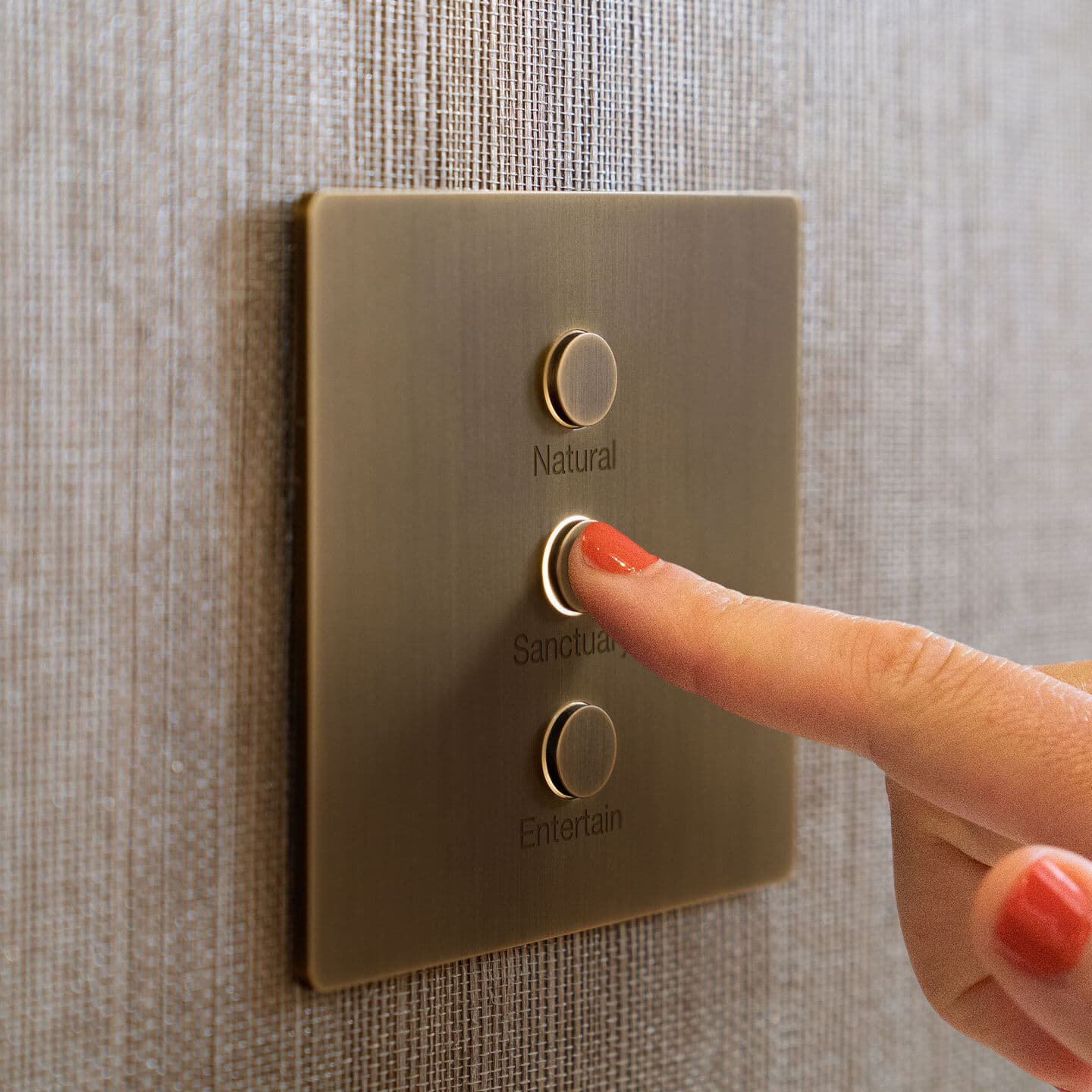
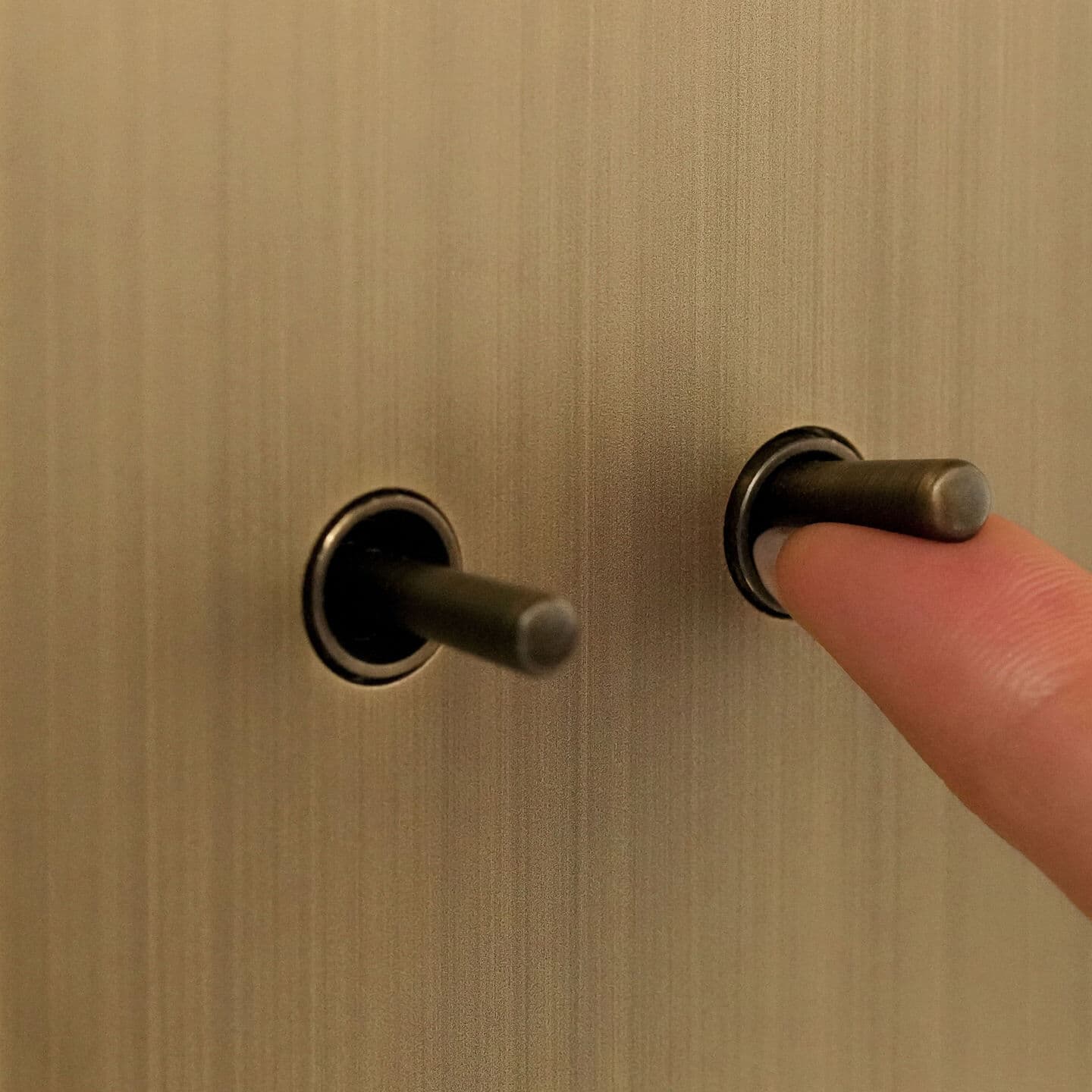
Lutron's architectural keypad lines: Palladiom Glass, Alisse, and Avienna.
Lutron — The Most Polished Lighting Platform, Period
Lutron is not an automation company. It is a lighting and shading company that happens to have software. That focus is why its lighting is unmatched. No other manufacturer comes close on dimming quality, shade motor reliability, keypad aesthetics, or the sheer depth of the product line. Lutron has been the luxury standard for decades and the gap to everyone else has only widened.
There are two Lutron platforms worth naming. HomeWorks QSX is the flagship whole-home lighting and shading system, used on estates where every circuit flows through a dedicated Lutron processor and purpose-built dimming modules. RadioRA 3 is the mid-range wireless system for smaller homes and retrofit projects where pulling low-voltage keypad wiring to every switch is not practical. Both integrate the same way with Crestron.
What Lutron delivers that no one else does:
- •Ketra tunable white and color lighting — the most advanced color-tuning technology in the industry. Spectral accuracy no other platform can match. Ketra is exclusive to Lutron.
- •HomeWorks QSX processors — dedicated hardware for lighting and shading, with purpose-built dimming modules engineered for every load type: incandescent, LED, ELV, MLV, and fluorescent.
- •Sivoia QS and Triathlon shade motors — decades of refinement in quiet, precise motorized shading. The fabric selection alone runs into the thousands.
- •Palladiom, Alisse, and Avienna keypads — architectural-grade hardware in dozens of finishes that no other manufacturer can replicate. These are jewelry on the wall, not plastic buttons.
- •Native LEAP integration with Crestron — lighting scenes, shade positions, and keypad button presses all pass between the two platforms in real time. Crestron touchpanels control Lutron as if it were native.
- •Twenty-year reliability — Lutron's proprietary Clear Connect RF and hardwired bus systems are engineered for lifetime residential service. Commercial buildings are still running Lutron processors installed in the 2000s.
Lutron does not make touchpanels, does not distribute video, and does not control the HVAC system. That restraint is exactly why they are the best at lighting. In the three-pillar model, Lutron is the layer you never replace because nothing else comes close to matching it.
Savant Power — The Electrical Backbone
Savant is no longer the Apple-like automation brand it was five years ago. After acquiring GE Lighting in 2020, the company pivoted its engineering and marketing focus toward a fundamentally different problem: the electrical system itself. Savant Power is now the platform the company leads with. It is a complete hardware ecosystem for home battery storage, solar integration, generator control, and intelligent circuit-level load management.
Savant Power is what allows a luxury home to ride through a multi-day outage without the homeowner noticing. When the grid drops, Savant Power decides which circuits stay on, for how long, and in what order. It is the difference between a house that survives a hurricane and a house that becomes a camping trip.
The Savant Power product line:
- •Savant Power Storage 20 and Power Storage 50 — all-in-one LFP battery and hybrid inverter systems. The PS20 is a 12.5 kW split-phase hybrid inverter with a 100A microgrid interconnect device, scalable from 20 kWh to 200 kWh per system. The PS50 scales up to 400 kWh of total storage across eight stacked units.
- •Savant Power Inverter — 12.5 kW continuous output with a 30 kW surge rating for 300 milliseconds, supporting DC-coupled solar through two built-in MPPTs plus AC-coupled solar and automatic generator integration.
- •Savant Smart Panel — the electrical panel that replaces or integrates with the existing one. This is what Savant Power Modules bolt into. Load management happens at the panel level, not the branch level.
- •Savant Power Modules — the circuit-level intelligence. Each module monitors and controls 20A, 30A, or 60A circuits. A 20A module covers two circuits, a 30A or 60A module covers one large load. Every module provides revenue-grade energy monitoring and instant outage detection.
- •Flexible load management — the system assigns priority to every circuit. When the grid goes down, low-priority loads like pool pumps and EV chargers drop first, while high-priority loads like refrigeration, HVAC, and networking stay on. No manual intervention required.
- •Energy management modes — Eco Mode maximizes solar and battery use to minimize grid consumption. Storm Watch automatically reserves all battery capacity ahead of a predicted weather event. Outage Mode disconnects from the grid entirely and runs the home on solar and battery.
- •Virtual Power Plant ready — Savant Power Storage can share real-time energy data with the utility, respond to demand-response events, and export stored energy back to the grid during peak pricing windows.
Savant Power can operate as a standalone system, but the real power comes from its integration with the rest of the house. A Crestron touchpanel can display current battery state of charge, solar production, grid draw, and per-circuit consumption. Lighting scenes can change based on battery level. Automations can fire when the home switches from grid power to battery. The electrical system stops being a separate thing and becomes part of the house.
Savant Power vs Tesla Powerwall and Enphase
The obvious question: why use Savant Power when Tesla Powerwall and Enphase already exist? The answer is that they are solving different parts of the problem. Tesla and Enphase are battery systems. Savant Power is an energy management platform that happens to include its own battery hardware — and can also integrate Tesla and Enphase when the homeowner has already chosen them.
Tesla Powerwall is a polished appliance. Enphase is a modular, microinverter-first architecture that excels when solar already uses Enphase gear. Both are excellent batteries. What neither one does well is circuit-level load management. Powerwall backs up whatever is wired to the gateway panel. Enphase backs up whatever is on the protected loads subpanel. Neither one intelligently decides, on a circuit-by-circuit basis, what should stay on during a three-day outage and what should not.
Savant Power does this at the panel level. Every circuit has its own priority. The refrigerator stays on. The EV charger throttles. The pool pump drops. The dehumidifier in the wine cellar runs because it has been flagged as mission-critical. This is what separates a home that survives an outage from a home that merely has some lights on during one.
In practice, Savant Power often pairs with Tesla or Enphase batteries rather than replacing them. Savant Power Modules install into the panel alongside whatever battery the homeowner has chosen, handling the load management layer while the existing battery handles storage. For a luxury home that wants full circuit-level control, the Savant Smart Panel is the integration piece that makes any battery system actually intelligent.
How the Three Pillars Work Together
In a typical modern luxury residence, the technology stack looks like this:
Lutron HomeWorks QSX — the lighting layer
Every light circuit and every motorized shade reports into the Lutron processor. The dimming modules live in a dedicated enclosure near the main panel. If the control system ever goes offline, the keypads still work directly. Lighting runs independently.
Savant Power System — the electrical layer
The Savant Smart Panel is the electrical distribution for the house. Savant Power Modules monitor and control every circuit. A Savant Power Storage inverter and battery stack is connected to the panel along with any solar array and the standby generator. The entire electrical system is managed as one unit.
Crestron Home OS — the nervous system
A CP4-R processor orchestrates the house. It communicates with Lutron over LEAP for lighting, with Savant Power over IP for energy data, with the HVAC system for climate, with DM NVX for video distribution, and with every other subsystem in the house. The homeowner interacts with Crestron touchpanels and the Crestron Home app.
Enterprise network — the foundation
A managed network with VLANs, PoE switches, and enterprise WiFi connects everything. The Lutron processor, Savant Power hardware, Crestron processor, cameras, audio zones, and personal devices each live on their own VLAN with firewall rules governing inter-VLAN traffic. Without the network, none of this works.
Unified experience
From a Crestron touchpanel, the homeowner sees the current battery state of charge, the solar production for the day, the house lighting scenes, the shade positions, the HVAC setpoints, and the security system — all on one interface. When grid power fails, the touchpanel shows the event, the Savant Smart Panel sheds low-priority loads automatically, and lighting scenes adapt to conserve battery. The homeowner does not have to do anything.
The integration between Crestron and Lutron is native and bidirectional over LEAP. The integration between Crestron and Savant Power flows over IP. The result is a system where the homeowner never thinks about which platform is handling which function. It all appears as one unified home.
What About Savant Pro — The Automation Platform?
Savant still sells its original automation platform. Savant Pro remains a product, with the Smart Host, Pro Host, and Super Pro Host controllers targeting homes of increasing size, and the Savant Pro app running on iOS, Android, and Apple Watch. It handles audio, video, climate, and lighting for homeowners who want a single app-driven experience without the depth of Crestron programming.
The honest take: Savant Pro is no longer the product the company is building its future around. Engineering focus, marketing spend, and industry positioning have all shifted toward Savant Power. Savant Pro is still a viable choice for a smaller home with modest automation requirements, but in a high-end installation where Crestron is running the control layer, the right call is almost always to skip Savant Pro and deploy Savant Power as the energy layer instead.
This is the shift that makes the three-pillar model work. Savant is no longer competing with Crestron for the nervous system role. Crestron owns that layer. Savant has moved to a layer Crestron does not play in — and that Crestron needs a partner for. Savant Power is that partner.
Who Actually Needs All Three
The three-pillar stack is the right answer for a specific kind of project. Not every home needs it, and not every homeowner will use everything it delivers. It makes sense when:
- •The home is in an area with unreliable grid power or hurricane risk — the Northeast, coastal Florida, the Hamptons, any property where a multi-day outage is a real scenario. Savant Power turns the home into an energy island.
- •There is existing or planned solar — Savant Power integrates with AC-coupled and DC-coupled solar and handles the battery side without a second platform. A solar install that does not include intelligent load management is leaving capability on the table.
- •The homeowner has high-value contents that cannot tolerate an outage — wine cellars, fine art with humidity requirements, freezers full of game, a home office that runs a business. Circuit-level prioritization protects what matters.
- •There is a whole-home generator already in place — Savant Power handles generator control alongside battery and solar, which means a single platform orchestrates the entire backup strategy instead of three disconnected systems all competing to supply power.
- •The home is a primary or significant secondary residence — a vacation house that sits empty half the year still needs climate control, security, and remote visibility. The three-pillar stack lets the owner see and control everything from anywhere.
- •The owner values a unified experience — no one wants to use three different apps. Crestron acts as the single pane of glass for Lutron lighting, Savant Power energy, and every other subsystem. One interface, one source of truth.
For homes that do not fit this profile, the answer is simpler. A Lutron-only installation is a great outcome for a home that primarily needs lighting and shading. Crestron plus Lutron without Savant Power is still the right call when grid reliability is not a concern. The three-pillar stack is for homes where the electrical system needs to be as intelligent as the automation system.
Why Your Integrator Matters More Than Your Platforms
The single biggest factor in how well any of this performs is not which platforms you choose. It is who designs and installs them. A poorly programmed Crestron system is worse than a well-programmed entry-level system. A Lutron installation with the wrong dimming modules will flicker regardless of how good the platform is. A Savant Power System installed without proper circuit prioritization will fail its first real test during an outage.
Most integrators specialize in one platform. Crestron dealers push Crestron. Savant dealers push Savant. Lutron-only dealers may not understand control system integration at all. The result is a system optimized for the integrator's expertise rather than the home's actual needs. The three-pillar approach requires certified depth in all three platforms plus the electrical knowledge to design a panel that actually does load management correctly.
Cave Group is certified in Crestron, Lutron, and Savant Power. We design systems based on what the home needs, not what we prefer to sell. That independence is why our clients end up with homes that run as a unified whole — control, lighting, and energy — rather than a collection of disconnected products stitched together with good intentions.
Planning a Project?
Whether you are building new, retrofitting an existing home, or trying to figure out how to add battery backup and intelligent load management to a system that already has Crestron and Lutron — we can help. We will assess your home, understand how you use technology and energy, and recommend the right combination of platforms for your specific situation.
Related Reading